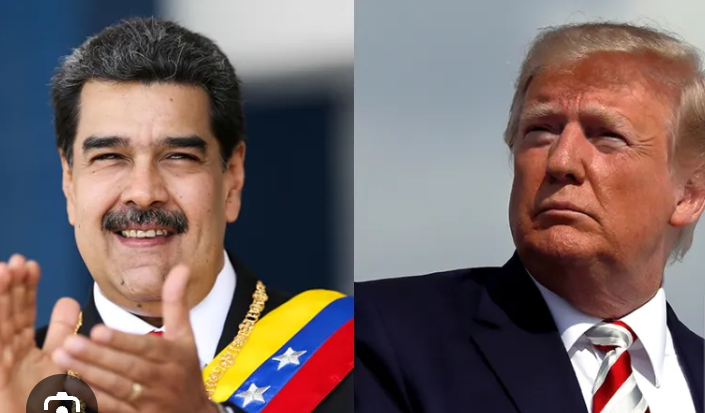
U.S. Launches Military Air Strikes on Venezuela as Pressure Mounts on Maduro
In a stunning escalation of U.S.-Venezuelan tensions, the United States has launched targeted military air strikes on Venezuela, hitting strategic military installations and key government-linked facilities. The operation, reportedly ordered directly by President Donald Trump, represents the most aggressive action yet in Washington’s ongoing campaign against Venezuelan President Nicolás Maduro,
In a stunning escalation of U.S.-Venezuelan tensions, the United States has launched targeted military air strikes on Venezuela, hitting strategic military installations and key government-linked facilities. The operation, reportedly ordered directly by President Donald Trump, represents the most aggressive action yet in Washington’s ongoing campaign against Venezuelan President Nicolás Maduro, who has faced increasing international scrutiny in recent months.
According to military sources, the strikes focused on multiple locations, including air bases, command centers, and areas tied to the Venezuelan military’s operational infrastructure. The U.S. Department of Defense confirmed the operation in a statement released early Wednesday morning, asserting that the strikes were “precisely coordinated to neutralize potential threats to regional stability while minimizing civilian casualties.” While details about the exact targets remain classified, officials indicate that the operation was conducted with both manned aircraft and precision-guided munitions.
The attacks follow a period of heightened U.S. military presence in the Caribbean, including the deployment of the USS Gerald R. Ford, the nation’s newest supercarrier, alongside several other naval vessels. Analysts say the show of force was part of a broader strategy aimed at pressuring the Maduro government, which the U.S. has repeatedly accused of corruption, drug trafficking, and collaboration with gangs designated as terrorist organizations.
In recent months, the Trump administration has taken a series of measures against Venezuela, escalating tensions to unprecedented levels. These measures include the seizure of two Venezuelan oil tankers, which were allegedly carrying illicit shipments, as well as strikes on more than 30 vessels suspected of transporting drugs in international waters. U.S. forces have also targeted Venezuelan dock areas reportedly used to load narcotics for export, signaling a focused campaign against the Maduro administration’s alleged criminal networks.
The U.S. has framed its operations as part of a regional security effort to curb the influence of organized crime and prevent the flow of illegal substances into the Americas. White House officials maintain that the strikes are intended to avoid a broader conflict, emphasizing that they are a direct response to threats posed by Maduro’s alleged activities rather than an effort to overthrow the Venezuelan government outright. Nonetheless, the military action has sparked fears of an escalation that could quickly spiral into a larger confrontation.
President Maduro, who has consistently denied any involvement in drug trafficking, condemned the U.S. strikes as an act of aggression and a violation of Venezuelan sovereignty. Speaking to state media, Maduro accused Washington of attempting to destabilize the country, calling the air strikes a “blatant attack on our people and our democratic institutions.” He vowed to defend Venezuela against what he described as an imperialist incursion, asserting that the government would respond “with all necessary measures to protect our nation.”
The U.S. government has dismissed Maduro’s claims as propaganda, highlighting its ongoing intelligence that allegedly links key figures in the Venezuelan administration to international drug networks. According to senior officials, evidence gathered over the past year has shown coordination between elements of the Venezuelan military, organized crime groups, and foreign terrorist organizations. These allegations have formed the basis for sanctions, diplomatic pressure, and now direct military action, though Maduro and his allies have repeatedly denied all wrongdoing.
Regional reaction to the strikes has been swift. Several Latin American governments expressed concern over the potential for the conflict to destabilize the region. While some nations supported U.S. actions as necessary to confront organized crime, others condemned the strikes as a dangerous precedent that could undermine international law and sovereignty. Neighboring Colombia, which shares a porous border with Venezuela, called for calm and urged all parties to seek a peaceful resolution, citing the risk of humanitarian fallout.
The humanitarian situation in Venezuela, already dire due to years of economic collapse and political unrest, has raised alarms among international organizations. Food and medicine shortages have worsened over the past year, with millions of Venezuelans relying on aid shipments to survive. Experts warn that military operations in the country could exacerbate the crisis, potentially displacing thousands more citizens and increasing the pressure on neighboring countries already struggling to accommodate Venezuelan refugees.
Analysts say the U.S. strikes are also a signal of Washington’s willingness to use military force in what it perceives as the fight against narco-terrorism. By targeting facilities and infrastructure tied to alleged criminal networks, the Trump administration aims to disrupt Maduro’s operational capabilities and send a message to allies in the region. Some military strategists suggest that the air strikes could be followed by additional covert operations, including cyberattacks or intelligence-gathering missions designed to weaken Maduro’s control without triggering a full-scale war.
Social media has been flooded with reactions from both supporters and critics of the U.S. action. Pro-Maduro accounts have accused the United States of aggression and imperialism, while opposition figures and Venezuelan exiles have hailed the strikes as a necessary intervention to confront a regime they describe as authoritarian and corrupt. International media coverage has varied widely, reflecting deep divides in how the situation is interpreted globally.
While the immediate consequences of the air strikes are still unfolding, experts agree that the long-term implications for U.S.-Venezuelan relations are significant. The operation has already intensified diplomatic tensions, with Maduro reportedly summoning his foreign ministers to discuss potential countermeasures and international legal challenges. Meanwhile, Washington appears prepared to maintain pressure, leveraging both military and economic tools to achieve its objectives in the region.
As the situation develops, questions remain about the potential for further escalation. Will the strikes provoke retaliatory attacks by Venezuelan forces, or will they compel Maduro to negotiate under international pressure? How will other global powers, including Russia and China, respond to U.S. military actions in a region where they have strategic interests? Analysts say the coming weeks could be critical in determining whether the confrontation leads to a temporary show of strength or a protracted crisis with far-reaching consequences for the Americas.
For now, Venezuela stands at a crossroads. The U.S. military air strikes represent not only a direct challenge to Maduro’s authority but also a stark reminder of the complex interplay between geopolitics, security, and humanitarian concerns in Latin America. As citizens brace for the aftermath of the attacks, the world watches closely, aware that the decisions made in the coming days could reshape the region’s political landscape for years to come.
In a statement late Wednesday, the White House reiterated its commitment to combating organized crime and protecting regional security, while Maduro’s government vowed a “firm and measured response” to any further aggression. Both sides appear entrenched, with little indication of compromise, leaving observers to speculate on what might come next in this unfolding saga that has captured global attention.
The air strikes mark a defining moment in U.S.-Venezuelan relations, signaling an unprecedented willingness by Washington to use military force to confront perceived threats in the Western Hemisphere. Whether this action achieves its strategic objectives or triggers unforeseen consequences remains uncertain. What is clear, however, is that the tension surrounding Maduro’s government has entered a new, more dangerous phase, with implications that could ripple f
ar beyond Venezuela’s borders.
Share this post
Related Posts

“Christmas Gift Arrived”: A Viral Baby Announcement and the Internet’s Most Nigerian Question Steal the Spotlight
What began as a simple, heartfelt Christmas post quickly turned into one of those internet...

Omotola Jalade Ekeinde Sparks Buzz As She Talks Love, Luxury, and Life With Omosexy
Nollywood icon Omotola Jalade Ekeinde has once again captured the spotlight, not for a film...

“Reverse Japa Is Coming” — Pastor E.A. Adeboye Releases 2026 Prophecy for Nigeria, Sparks Mixed Reactions
The General Overseer of the Redeemed Christian Church of God (RCCG), Pastor Enoch Adejare Adeboye,...