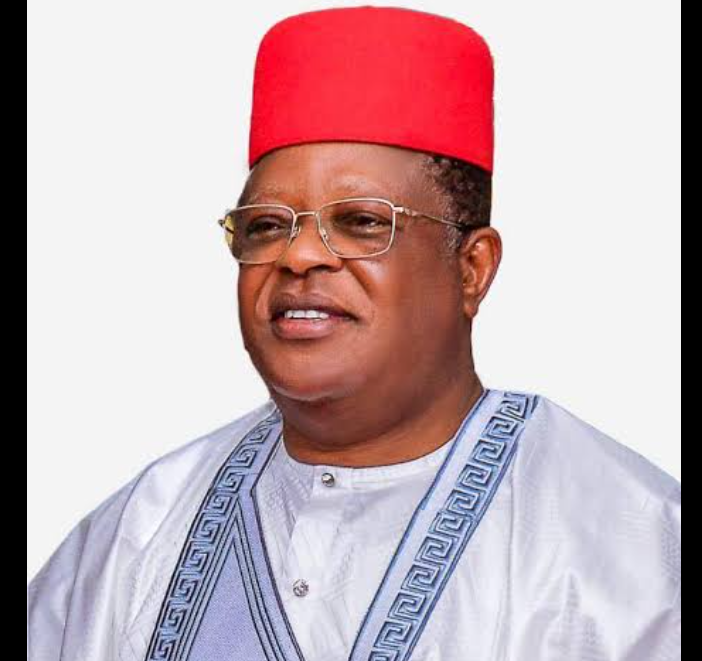
‘I Am Very Dangerous Now’: Umahi’s Bold Declaration Sparks Buzz in Ngbo
Nigeria’s Minister of Works, David Umahi, has set social media and political circles abuzz following a fiery and confidence-laden address to youths and residents of his hometown, Ngbo, where he declared that his current political capacity is “ten times” what it was when he served as governor of Ebonyi State.
Nigeria’s Minister of Works, David Umahi, has set social media and political circles abuzz following a fiery and confidence-laden address to youths and residents of his hometown, Ngbo, where he declared that his current political capacity is “ten times” what it was when he served as governor of Ebonyi State. Speaking in a tone that blended reassurance, bravado and a call for unity, Umahi urged his people to remain steadfast, ignore critics and rally behind him for the development of their community.
The former governor, who now oversees critical infrastructure projects across the country as Minister of Works, addressed a gathering of community members in Ngbo with a message that was both deeply personal and politically charged. He repeatedly appealed to the crowd to see him not just as a national figure but as one of their own. “You must accept me as one of your own. Don’t listen to noise makers. My capacity is like ten times when I was governor,” he told the audience, drawing cheers and applause.
Umahi’s statement that he is now “very, very dangerous” quickly became the standout line of the event. “I’m very, very dangerous now. Let nobody fall on me because the cost is very dangerous,” he declared emphatically. While the remark may have sounded combative at first hearing, supporters at the event appeared to interpret it as a metaphor for political strength and influence rather than a literal threat. The applause that followed suggested the crowd saw it as a bold assertion of his ability to deliver results at a higher level of governance.
The minister’s remarks come at a time when infrastructure development remains one of the most pressing issues in Nigeria. As Minister of Works, Umahi oversees federal road projects and other key infrastructure initiatives that are central to economic growth. His supporters often point to his record as governor of Ebonyi State, where he was widely credited with investing heavily in road construction and public works. In Ngbo, he appeared keen to reassure residents that his move to the federal cabinet has only expanded his capacity to influence development projects.
Throughout his speech, Umahi sought to keep the audience engaged with repeated calls of “Nnoo nu o?” — a local expression meaning “Are you there?” The phrase, delivered in Igbo, was met with enthusiastic responses, creating an atmosphere that blended political rally with communal gathering. It was a reminder that despite his national role, he remains deeply rooted in his local identity.
Unity was a recurring theme in his address. Umahi urged prominent sons and daughters of Ngbo to set aside differences and work collectively for the advancement of their community. “We have the capacity to do good things for the Ngbo people. Come together. Tell your sons and daughters — very illustrious and industrious — to come together. Let them approach me. Whatever is their need, they will have it done,” he said.
Observers note that such calls for unity are not uncommon in Nigerian politics, particularly when leaders return to their constituencies. However, Umahi’s emphasis on collective effort, coupled with a strong assertion of his own power, struck a distinctive tone. By positioning himself as both a benefactor and a bridge to federal influence, he reinforced his image as a key political figure capable of attracting projects and investments to his home community.
In a particularly striking segment of his speech, Umahi highlighted the financial strength of his family, stating that they have been blessed “beyond words” and are capable of funding major community projects. “This Umahi family now, God has blessed them beyond words and they are capable of funding anything,” he said. He further assured residents that members of his family are willing to contribute generously to communal initiatives. “If you ask them to contribute, they will contribute, and they will over-contribute,” he added.
Such declarations underscore the complex interplay between personal influence, family networks and public service in Nigerian politics. In many communities, political leaders are often seen not only as office holders but also as patrons whose personal resources can supplement public funding. Umahi’s comments appeared to align with this tradition, presenting his family’s wealth as an additional asset for Ngbo’s development.
Reactions to the speech have been mixed. Supporters describe it as a passionate reaffirmation of commitment to grassroots development. They argue that Umahi’s confidence reflects his experience and expanded authority at the federal level. For them, his assertion of being “dangerous” is simply political language meant to convey determination and strength in the face of opposition.
Critics, however, have questioned the tone of some of his remarks, suggesting that public officials should exercise caution in their choice of words. In a political climate often marked by heated rhetoric, statements that can be interpreted as combative may invite scrutiny. Nonetheless, there is no indication that Umahi intended his comments as anything more than metaphorical expressions of resolve.
What is clear is that Umahi remains a dominant figure in Ebonyi State politics, even after transitioning to a federal role. His continued engagement with his home community signals that he is keenly aware of the importance of maintaining local support while operating on a national stage. By directly addressing youths and urging them to ignore “noise makers,” he appeared to be responding to critics or rival factions, although he did not name anyone specifically.
The emphasis on youth engagement is also significant. Across Nigeria, young people represent a powerful demographic whose support can shape political outcomes. By speaking directly to them and encouraging unity, Umahi positioned himself as both mentor and advocate, seeking to inspire confidence in his leadership.
As Nigeria grapples with economic challenges and infrastructure deficits, the role of the Minister of Works is particularly critical. Roads, bridges and transport networks are not merely construction projects; they are lifelines for commerce, agriculture and daily life. Umahi’s claim that his capacity has multiplied since becoming minister suggests that he sees his current office as a platform for broader impact.
Whether his bold declarations translate into tangible benefits for Ngbo and other communities remains to be seen. For now, his speech has succeeded in capturing public attention and reigniting conversations about leadership style, political rhetoric and the expectations placed on public officials.
In Ngbo, however, the mood appeared celebratory rather than skeptical. The applause that followed his statements indicated a community eager to believe in his promise of expanded influence and accelerated development. As he concluded his remarks, the message was clear: he sees himself as empowered, emboldened and ready to deliver — and he wants his people to stand united behind him.
In Nigerian politics, words often carry as much weight as actions. With his declaration that he is “very dangerous now,” David Umahi has once again demonstrated his flair for dramatic expression. The coming months will reveal how that confidence shapes both his ministerial performance and his enduring relationship with the people of Ngbo.
Share this post
Related Posts

“I Don’t Work for Money” — Davido Says He Has Billions Waiting from His Father’s Empire
Afrobeats superstar Davido has set social media ablaze once again—not with a chart-topping song, but...

\"Remove the Poor Masses from Your Church and It\'ll Be Empty\": A Bold Critique of Religious Leaders Amidst the 30-Day Rant Challenge
In recent weeks, a social media phenomenon known as the \"30-Day Rant Challenge\" has taken...

Fear and Flight in Ortese as Fresh Attacks Leave Trail of Death, Abductions, and Displacement
Residents of Ortese community in Benue State are grappling with renewed fear and grief following...